Grazing vs. Washing: The Lighting Decision That Defines How a Facade Looks After Dark
September 12, 2026
Why Older Lighting Quietly Drains Your Building
Wiring Sets the Boundaries
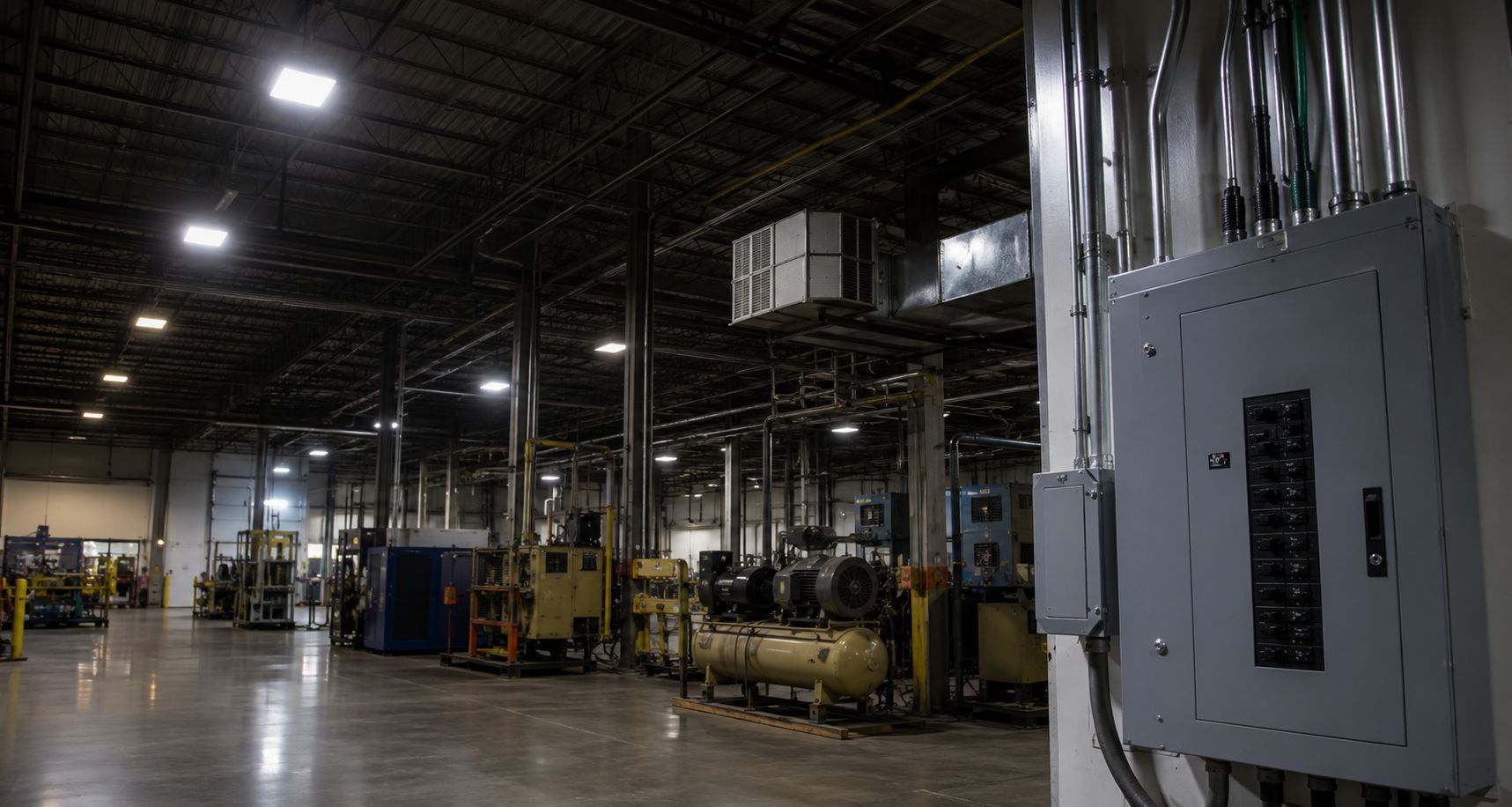
What a home's existing wiring can support shapes what the lighting plan can include, which is why the plan should come after someone looks at the panel and the switch boxes.
Several practical limits come up repeatedly. Older switch locations may lack a neutral conductor, which affects which dimmers and smart controls will work. Adding recessed cans across a large open room can push a circuit toward its limit if that circuit already carries other loads. Splitting a room's ambient, task, and accent layers onto separate controls means running additional switch legs, which is far easier during a remodel than after drywall goes up. Outdoor systems need a transformer sized for the total fixture load with headroom left for future additions, plus attention to voltage drop on long runs so the last fixture in the line is as bright as the first.
Dimmer compatibility deserves its own mention. LED drivers and dimmers are not universally interchangeable, and a mismatch shows up as flicker, buzzing, or a narrow dimming range that drops from full output straight to off.
Watch the spread
Note whether one fixture, one area, or the whole building flickers. That single observation separates a fixture problem from a feeder or service problem.
Use your senses at the panel, carefully
Without opening the panel, feel whether the cover is warm, listen for buzzing, and check for any burning smell. If you notice any of these, keep people away from the panel and treat it as urgent.
Do not keep resetting or ignoring it
Flicker that comes with heat or smell will not fix itself, and running equipment through repeated voltage dips shortens its life. Once the basic safe checks point to anything beyond a loose lamp or a single bad fixture, the wiring, panels, and service belong to a licensed electrician with the right test instruments.
Quick Answer: Facade lighting looks different from one building to the next mostly because of how fixtures are aimed, not because of which fixtures were used. Grazing mounts fixtures close to a wall to skim light across the surface at a narrow angle, sharpening texture and casting shadow lines that bring out brick, stone, or stucco relief. Washing mounts fixtures farther back to spread light evenly at a wider angle, smoothing a surface and suiting flat, uniform materials like glass, EIFS panels, or painted concrete. Color temperature refines the effect further: warm light around 2700K to 3000K draws out the natural tone in brick and stone, while neutral to cool light near 4000K gives glass and metal a sharper, more contemporary read. Get technique and color temperature right and a facade reads clearly after dark instead of looking flat or overexposed.
Drive past two buildings with nearly identical brick exteriors after sunset, and one might glow with depth and warmth while the other looks flat, washed out, or barely visible at all. The fixtures on each building could be nearly identical. The difference usually comes down to two decisions made before a single bracket goes on the wall: which lighting technique gets used where, and which color temperature runs through it.
Grazing, Washing, and Scalloping: Three Ways to Light the Same Wall
Grazing
Fixtures sit close to the wall, often within about a foot, and aim at a narrow beam angle of roughly 15 to 30 degrees. That steep angle catches every ridge, joint, and irregularity in the surface and turns it into a shadow line. Grazing is the technique that makes brick, natural stone, board-formed concrete, and textured stucco look three-dimensional after dark instead of flat.
Washing
Fixtures pull back from the wall, typically 2.5 to 3 feet, and spread light at a wider angle. A single row set at that distance can evenly cover roughly 8 to 9 feet of vertical wall height. Because the light hits the surface at a shallow, uniform angle, shadows flatten out and the wall reads as smooth and continuous. This is the better choice for glass curtain walls, painted concrete, EIFS panels, and signage backdrops, where texture isn't the point.
Scalloping
Fixtures are spaced along the base of a wall and angled so the light pools overlap, creating a repeating wave pattern of bright and dark. It's a decorative technique more than a functional one, often used along colonnades, evenly spaced columns, or a run of matching windows where rhythm matters more than uniform coverage.
Most commercial facades use more than one of these at once. A building with a stone base and a glass upper floor rarely gets the same treatment top to bottom.
Color Temperature: Matching Light to What the Building Is Made Of
Color temperature is measured in Kelvin, and it changes how a material reads even when the amount of light stays the same.
Warm light (2700K to 3000K) draws out the natural tone in brick, natural stone, and other masonry. It softens the contrast between mortar joints and brick faces and tends to look intentional rather than harsh.
Neutral to cool light (4000K and above) suits glass, metal panels, and painted concrete. It gives those materials a sharper, more contemporary edge and photographs closer to true white.
Historic or older masonry often looks better under an even warmer range, around 2200K to 2700K, closer to the gas and incandescent light such buildings were originally designed to sit under at night.
Color rendering index (CRI) matters alongside color temperature. At CRI 90 and above, brick and stone show their actual color and grain instead of appearing dull or slightly gray under the light, which is the difference between a fixture that lights a wall and one that reveals it.
Tip: Walk the property after dark before choosing anything. Note where you actually slow down, where you reach for a phone flashlight, and where you cannot see a face at the door. Those three spots are the ones worth solving first.
Uplighting, Downlighting, and Accent Lighting: Layering the Effect
Uplighting places fixtures at ground level, aimed upward. It's the technique behind most dramatic grazing effects on columns, pilasters, and tall vertical wall sections, since the upward angle creates the deepest shadow play.
Downlighting mounts fixtures higher on the building, at a soffit, cornice, or parapet, and aims them down. Because the light spills toward the ground rather than into a passerby's line of sight, downlighting tends to control glare more easily and is a common choice along rooflines and overhangs.
Accent or spot lighting uses a narrow beam aimed at one specific feature: an entrance, a sign, a column capital, a decorative cornice detail. Its job isn't to cover a wall, it's to pull the eye to a single point.
A well-planned facade rarely relies on just one of these. Broad wall coverage from grazing or washing sets the base layer, and uplighting, downlighting, or accent fixtures add emphasis on top of it.
Aiming and Shielding: Keeping Light on the Building, Not Off It
The goal of a well-aimed fixture is simple: light stays on the building surface it was meant to hit, rather than spilling into the sky or across a property line. Shielded, properly aimed fixtures control where the beam goes and cut down on glare for drivers and neighboring properties.
Careful aiming also protects the effect itself. Light that spills past the edge of a wall or bounces off a nearby surface softens the exact contrast that grazing or washing was designed to create in the first place, so a facade lighting system that looks sharp on paper can end up looking muddy if the aiming isn't precise during installation.
Most systems also run on photocells or timers rather than a manual switch, so the lighting activates at dusk and shuts off at a set hour instead of running at full output all night.
Where Facade Lighting Earns Its Keep: Entrances and Focal Points
A facade with a clear brightness hierarchy reads better after dark than one lit evenly from top to bottom. The main entrance is usually the brightest point on the building, since it's the spot a visitor's eye needs to land on first. Secondary features, a sign, a column run, a decorative cornice, sit a step down in brightness. Broad wall washing or grazing forms the base layer beneath that, and rooflines or purely decorative accents sit dimmer still.
That layering is what makes a building look designed rather than simply switched on. A single flat wash of even brightness across an entire facade tends to flatten the architecture it was meant to highlight, while a deliberate hierarchy of bright to dim guides the eye the same way daylight and shadow do naturally.
Frequently Asked Questions
What's the difference between grazing and wall washing on a building facade?
Grazing mounts fixtures close to the wall at a narrow angle, bringing out texture on brick and stone. Washing spreads light evenly from farther back, suiting smooth surfaces like glass.
What color temperature works best for lighting brick or stone?
Warm light around 2700K to 3000K works best for brick and stone, drawing out natural tone and softening mortar joint contrast. Historic masonry often looks better closer to 2200K, too.
Can uplighting and downlighting be used on the same building?
Yes, combining them is common on commercial facades. Uplighting highlights columns and vertical sections with shadow, while downlighting along rooflines and cornices aims downward, helping control glare across the property.
Does facade lighting create glare for drivers or nearby properties?
Only when fixtures aren't properly aimed and shielded. A well-designed system keeps light on the building it's meant to illuminate, not spilling into the sky or onto neighboring properties instead.
How many lighting techniques does a typical facade project use?
Most commercial facade projects combine two or three techniques rather than one. Wall washing covers broad flat surfaces, grazing highlights textured entries, and accent lighting focuses on signs or entrances.
Are LED fixtures suitable for grazing and wall washing?
Yes, LED fixtures suit both techniques on most current facade projects. They come in narrow and wide beam spreads and a range of color temperatures, matching each fixture to material.
Let the Building's Materials Lead the Design
A facade lighting plan only works when it starts with the materials on the wall, not the fixtures in a catalog. Brick asks for a different angle than glass, and a building with both needs two plans running side by side rather than one blanket approach. Getting that sequence right, materials first, technique second, fixture last, is what keeps a building from looking merely lit and instead makes it look considered, with shadow and warmth placed exactly where they belong.
TRI ELECTRIC COMPANY, INC.
has spent 20+ years wiring and lighting commercial and industrial properties throughout Houston, TX, work that has meant learning how different facade materials actually respond to light once the sun goes down. That background shapes every plan the team puts together, from the beam angle chosen for a stone entry to the color temperature selected for a glass tower above it. The result is a facade that reads with intention after dark, not one simply switched on.